
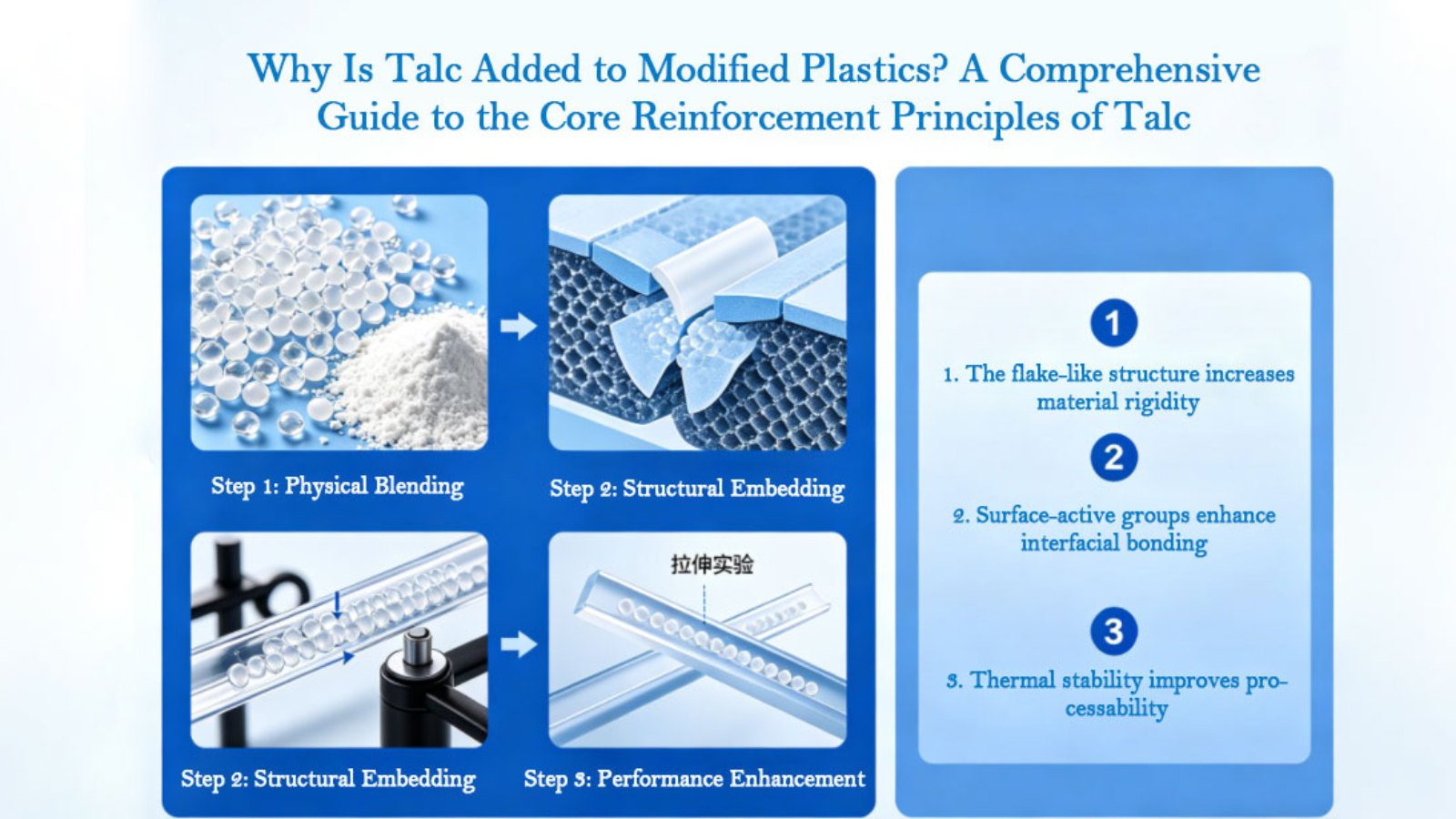
In the plastic modification industry, whether it’s PP injection molding, ABS appliance housings, automotive interiors, pipes, or cable compounds, talc is almost always a frequently used inorganic filler. Many customers ask: Why are more and more modified plastic manufacturers choosing talc instead of using resin alone or opting for calcium carbonate?
The answer is simple: talc not only reduces costs but, more importantly, it provides plastics with “structural reinforcement.”
I. Why Does Talc Reinforce Plastics?
From a mineral structure perspective, talc’s main component is hydrated magnesium silicate, which possesses a natural flaky crystal structure. This unique layered structure allows talc to form a supportive network within the plastic matrix, acting like “micro-reinforcing bars.”
When talc is uniformly dispersed in resin systems such as polypropylene (PP), polyethylene (PE), and ABS, it effectively restricts the free movement of polymer chains, thereby enhancing the overall mechanical properties of plastic products.
The core principles of this reinforcement are primarily reflected in the following aspects:
1. Enhanced Rigidity and Flexural Modulus
Adding an appropriate amount of talc to modified plastics typically results in a significant improvement in the product’s flexural strength and compressive resistance, with particularly notable performance in polypropylene (PP) modification systems.
For example, products such as automotive dashboards, home appliance housings, and logistics containers require high structural strength. Adding talc makes these products stiffer and less prone to deformation.
2. Improved Heat Resistance
Plastics tend to soften in high-temperature environments, whereas talc exhibits excellent thermal stability.
The addition of talc increases the material’s heat deflection temperature (HDT), helping plastics maintain dimensional stability in scenarios such as high-temperature injection molding and applications near automotive engine compartments.
This is a key reason why the automotive industry extensively uses talc-reinforced PP materials.
3. Improved Dimensional Stability
Plastic products are prone to issues such as shrinkage, warping, and dimensional instability during the cooling process.
The flake-like structure of talc effectively suppresses material shrinkage and reduces the rate of dimensional change after molding, which is particularly critical for precision injection-molded parts, structural components in home appliances, and industrial accessories.
4. Improving Molding Efficiency and Reducing Overall Costs
In addition to performance enhancements, talc possesses excellent lubricity, which improves melt flow and increases plasticization efficiency.
At the same time, partially replacing resin with talc powder can effectively reduce raw material costs and enhance product competitiveness in the market.
II. Which Modified Plastic Applications Rely on Talc Powder?
Currently, talc powder is widely used in:
Automotive modified plastics (bumpers, door panels, dashboards)
Home appliance plastics (refrigerator, washing machine, and air conditioner housings)
Pipe plastics (PVC, PE, PP-R)
Cable compounds and flame-retardant materials
Packaging and sheet materials
Engineering plastic reinforcement systems
Particularly with the trend toward lightweighting in new energy vehicles, market demand for talc continues to grow.
III. Talc Selection Determines Modification Results
Not all talc is suitable for plastic modification. Particle size, whiteness, aspect ratio, purity, and dispersibility all directly impact the performance of the final product.
If you are also interested in topics such as “the role of talc in modified plastics,” “how to control the talc-to-PP ratio,” or “which is better: talc or calcium carbonate,” we welcome ongoing discussion to jointly explore modification solutions that offer the best value for money.
Add a Comment