
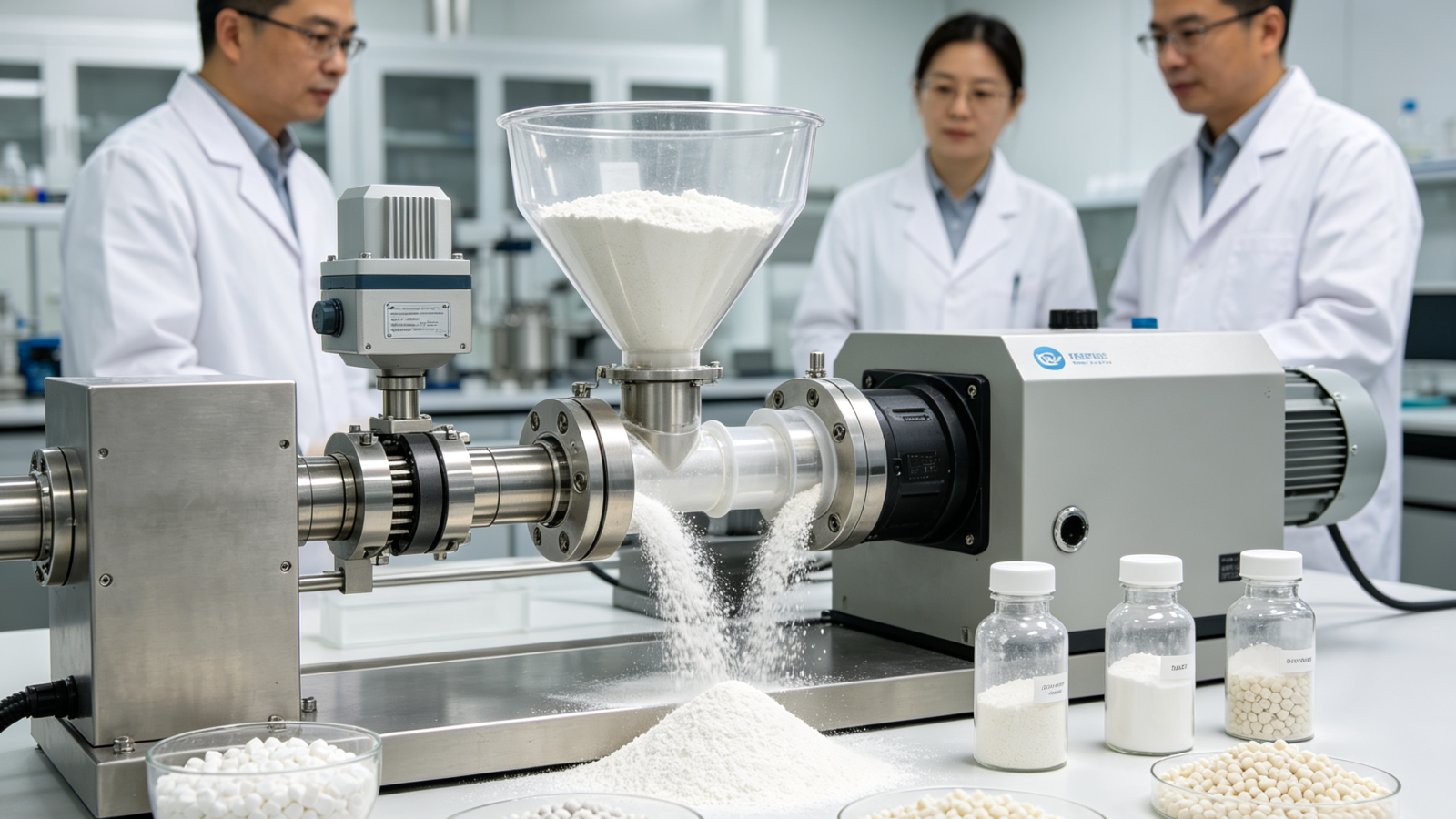
If you compare a standard PLA 3D printed part with a high-stiffness modified PLA part of the same size, the difference can often be felt immediately. Some parts bend more easily, while others remain noticeably more rigid.
This difference is closely related to elastic modulus, filler structure, polymer chain mobility, and crystallization.
So, how does talc powder improve the stiffness of PLA 3D printed parts?
The mechanism can be understood through three key effects:
Mineral reinforcement → Polymer chain restriction → Crystallization promotion
1. Talc Provides a Rigid Mineral Reinforcement Structure
Talc is a naturally occurring inorganic mineral with relatively high stiffness compared with polymer materials.
When fine talc particles are uniformly dispersed in a PLA matrix, they can act as rigid support points within the polymer structure. Under external loading, these mineral particles can reduce the extent of polymer deformation and contribute to a higher elastic modulus.
In simple terms:
Pure PLA:
Polymer chains can move and deform relatively easily under stress.
PLA + Talc:
Rigid mineral particles provide additional structural support and restrict part of the polymer deformation.
Research on PLA/talc composites supports this trend. One study reported that adding 10 wt% talc increased the Young’s modulus of PLA by approximately 35% compared with unfilled PLA. Other research has also found that the elastic modulus of PLA/talc composites generally increases as talc loading increases.
For applications requiring higher stiffness and structural support, talc can therefore be an effective mineral modification component.
2. Talc Can Restrict Polymer Chain Mobility
The second mechanism occurs at the polymer-mineral interface.
PLA consists of long polymer chains that can move and rearrange when subjected to heat or mechanical stress. When talc particles are well dispersed throughout the PLA matrix, their surfaces can interact with the surrounding polymer chains and restrict local chain movement.
A simple way to visualize this is to imagine polymer chains as flexible ropes. Adding rigid talc particles is similar to placing rigid structures between those ropes.
When external force is applied, the movement of some polymer chains becomes more restricted.
As a result, the composite can show:
- Higher stiffness
- Higher modulus
- Reduced deformation
However, this effect requires a proper balance.
Excessive talc loading, poor dispersion, or weak interfacial bonding can create stress concentrations and negatively affect toughness, elongation, or interlayer performance.
Therefore, higher filler loading does not automatically mean better 3D printing performance.
3. Talc Can Promote PLA Crystallization
Talc can also improve PLA stiffness through its influence on crystallization.
Talc particles can act as heterogeneous nucleating sites for PLA crystallization. Their surfaces provide locations where polymer chains can begin forming more ordered structures.
Research has shown that talc can significantly accelerate PLA crystallization. Under specific conditions, adding 5 wt% talc increased PLA crystallinity from approximately 7.8% to 28.3%, while another PLA system reached approximately 36.9% crystallinity with 15 wt% talc.
Higher crystallinity can contribute to changes in stiffness and thermomechanical performance.
However, crystallinity should not simply be maximized. The optimal level depends on the PLA grade, thermal history, cooling rate, printing temperature, and interlayer bonding requirements.
4. Why Is This Particularly Important for FDM 3D Printing?
FDM printing follows a unique thermal cycle:
Melting → Extrusion → Deposition → Rapid Cooling
Unlike injection molding, an FDM part is built from multiple layers of extruded filament. The final properties therefore depend not only on the material formulation but also on cooling conditions, printing direction, layer bonding, printing speed, and crystallization behavior.
Research on PLA/Talc for FDM has found that talc can promote PLA crystallization during rapid cooling. The resulting crystallization behavior may contribute to improved stiffness and mechanical integrity of printed parts.
This is one reason why 3D printing grade talc should not simply be treated as conventional plastic filler talc.
The powder needs to be compatible with the entire process:
Talc → PLA compounding → Filament extrusion → FDM printing → Final part
What Do Xufeng’s Tests Show?
Xufeng Powder has conducted application testing using 20% talc loading in PLA filament, evaluating XY tensile strength, XY elongation at break, flexural strength, and Z-direction tensile strength.
| Sample | XY Tensile | XY Elongation | Flexural Strength | Z Tensile |
|---|---|---|---|---|
| Conventional Talc | 25 ± 2 MPa | 6.1 ± 2% | 50 ± 2 MPa | 10 ± 2 MPa |
| XF-150-F1 | 30 ± 2 MPa | 3.6 ± 1% | 65 ± 1 MPa | 10.5 ± 2 MPa |
| XF-1851-F1 | 35 ± 2 MPa | 5.8 ± 1% | 73 ± 1 MPa | 11.8 ± 2 MPa |
| NC-60A | 28 ± 2 MPa | 8.9 ± 2% | 58 ± 1 MPa | 18.2 ± 2 MPa |
| XF-29610-T06 | 29 ± 2 MPa | 9.3 ± 1% | 63 ± 1 MPa | 18.4 ± 2 MPa |
| FTD-1201Y | 39 ± 2 MPa | 15 ± 2% | 59 ± 1 MPa | 22 ± 2 MPa |
Under the same 20% loading condition, the different talc grades produced noticeably different mechanical results.
For example, the FTD-1201Y sample achieved an XY tensile strength of 39 ± 2 MPa, Z-direction tensile strength of 22 ± 2 MPa, and XY elongation at break of 15 ± 2%.
This demonstrates that the performance of talc-filled PLA depends on much more than filler loading.
Conclusion: Talc Improves PLA Stiffness Through Multiple Mechanisms
The stiffness improvement of talc-filled PLA can be understood through three main mechanisms:
1. Rigid mineral reinforcement
Talc particles provide physical support within the PLA matrix.
2. Restricted polymer chain mobility
Well-dispersed talc can limit local movement of PLA polymer chains.
3. Crystallization promotion
Talc can act as a heterogeneous nucleating agent and influence PLA crystallization.
For FDM 3D printing, these effects interact with extrusion conditions, cooling rate, printing parameters, and interlayer bonding.
Therefore, the goal of using talc is not simply to “make PLA harder.”
The real objective is to select the appropriate talc grade, particle characteristics, loading level, and processing conditions to achieve the right balance of stiffness, strength, toughness, crystallization, dimensional stability, and printability.
Xufeng Powder develops specialty talc solutions for PLA and other 3D printing materials, supported by filament and application testing to help manufacturers evaluate suitable mineral filler solutions.
Add a Comment