
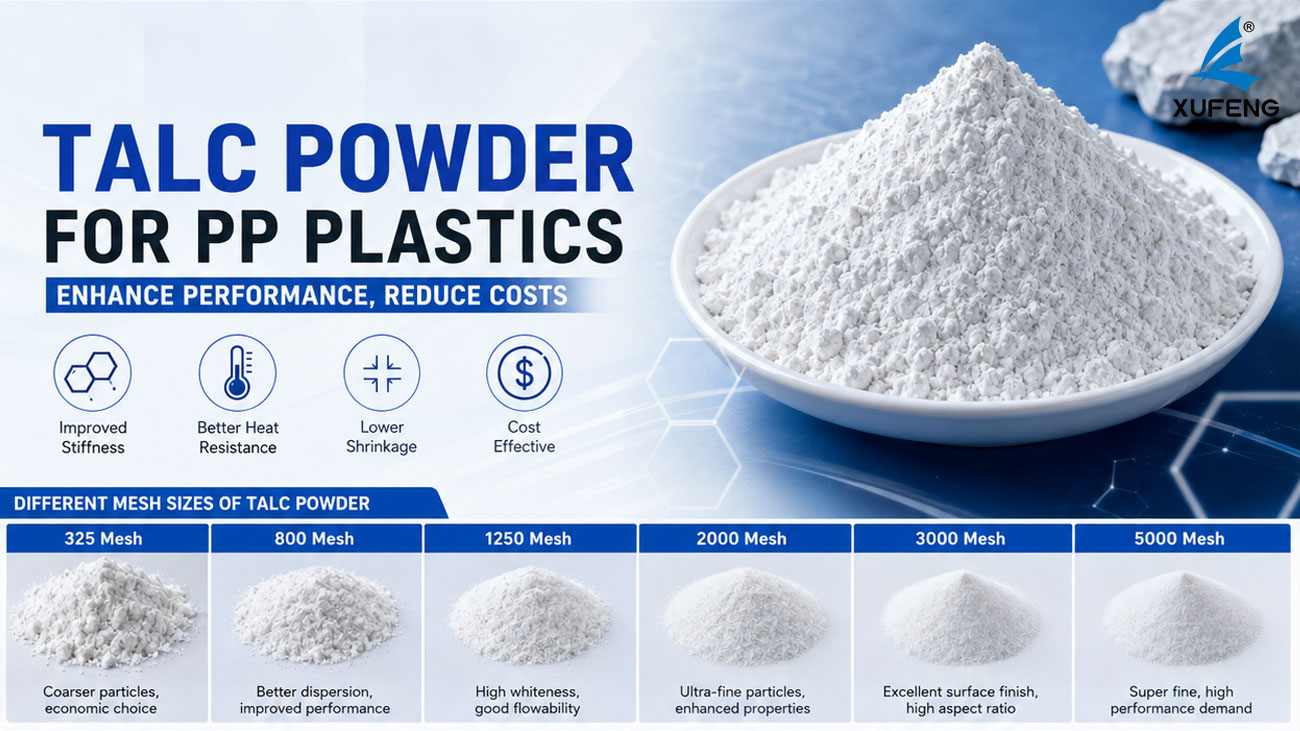
The best mesh size of talc powder for polypropylene (PP) depends on the specific application and performance requirements. Generally, finer talc powder provides better dispersion, smoother surface finish, and improved mechanical properties in PP compounds.
For standard injection molding applications, 800–1250 mesh talc is commonly used because it offers a good balance between stiffness improvement and processing efficiency. In automotive interior parts and high-rigidity PP compounds, ultra-fine talc grades such as 1250 mesh or higher are preferred for better dimensional stability, scratch resistance, and low warpage performance.
For packaging materials or cost-sensitive products, coarser talc grades may still be suitable. However, excessively coarse particles can reduce surface quality and impact the dispersion effect during compounding.
In addition to mesh size, manufacturers should also consider particle shape and aspect ratio. Plate-like talc with a high aspect ratio often delivers better reinforcement effects in PP compared with ordinary mineral fillers.
Choosing the right talc mesh can significantly affect melt flow, rigidity, heat distortion temperature, and final product appearance. Therefore, talc selection should match the target application, processing method, and performance goals.
