
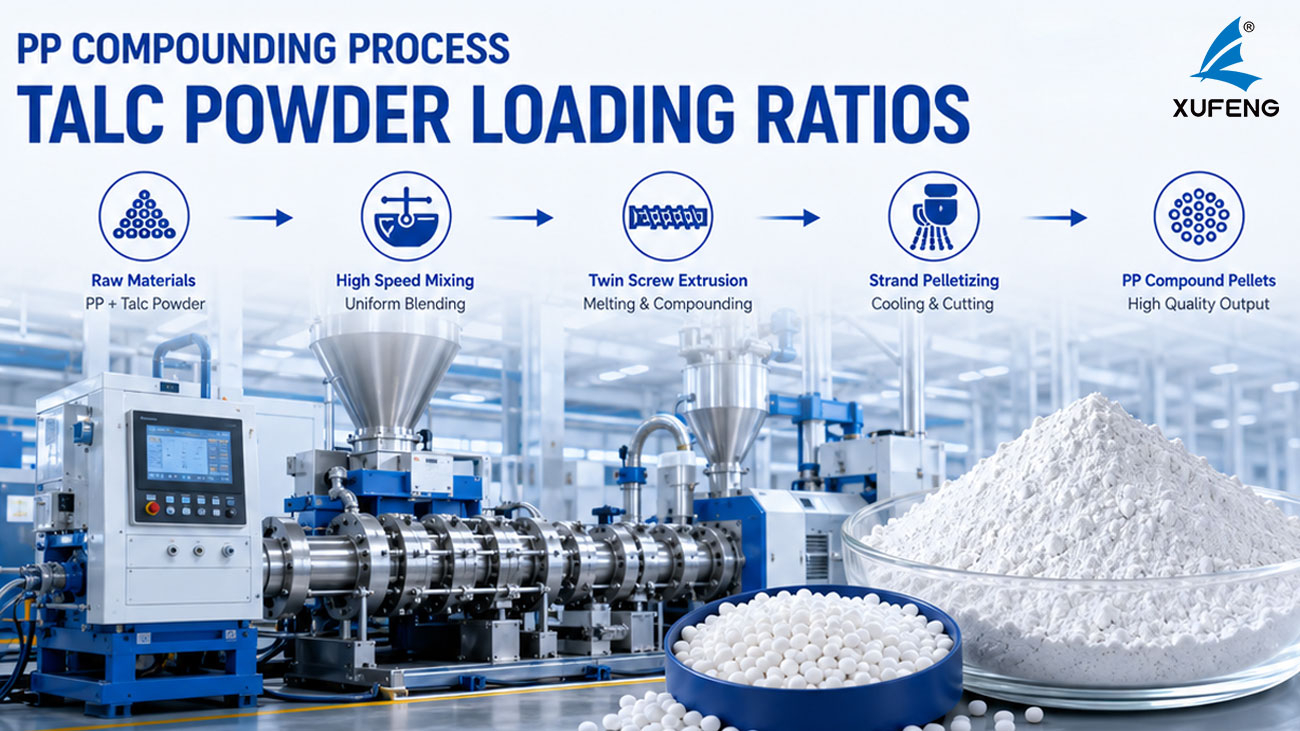
The amount of talc powder added to polypropylene (PP) depends on the desired balance between mechanical performance, processing behavior, and cost control. In most PP modification applications, talc loading typically ranges from 10% to 40%.
For general rigid PP products, adding 10–20% talc can effectively improve stiffness, dimensional stability, and heat resistance while maintaining acceptable toughness. In automotive interior components, home appliance housings, and engineering plastics, talc content may increase to 20–30% to achieve higher rigidity and lower shrinkage.
Some high-filled masterbatch systems can even contain over 40% talc, especially when cost reduction and rigidity enhancement are key objectives. However, excessive talc loading may negatively affect impact strength, elongation, and processing flow if the formulation is not properly optimized.
The actual addition level should also consider talc particle size, surface treatment, resin grade, and processing equipment. Surface-modified talc generally offers better compatibility with PP matrices, helping maintain balanced mechanical properties even at higher filler levels.
Proper formulation design is essential to achieve optimal performance. Manufacturers often conduct formulation trials to determine the best talc loading ratio for specific end-use applications.
