
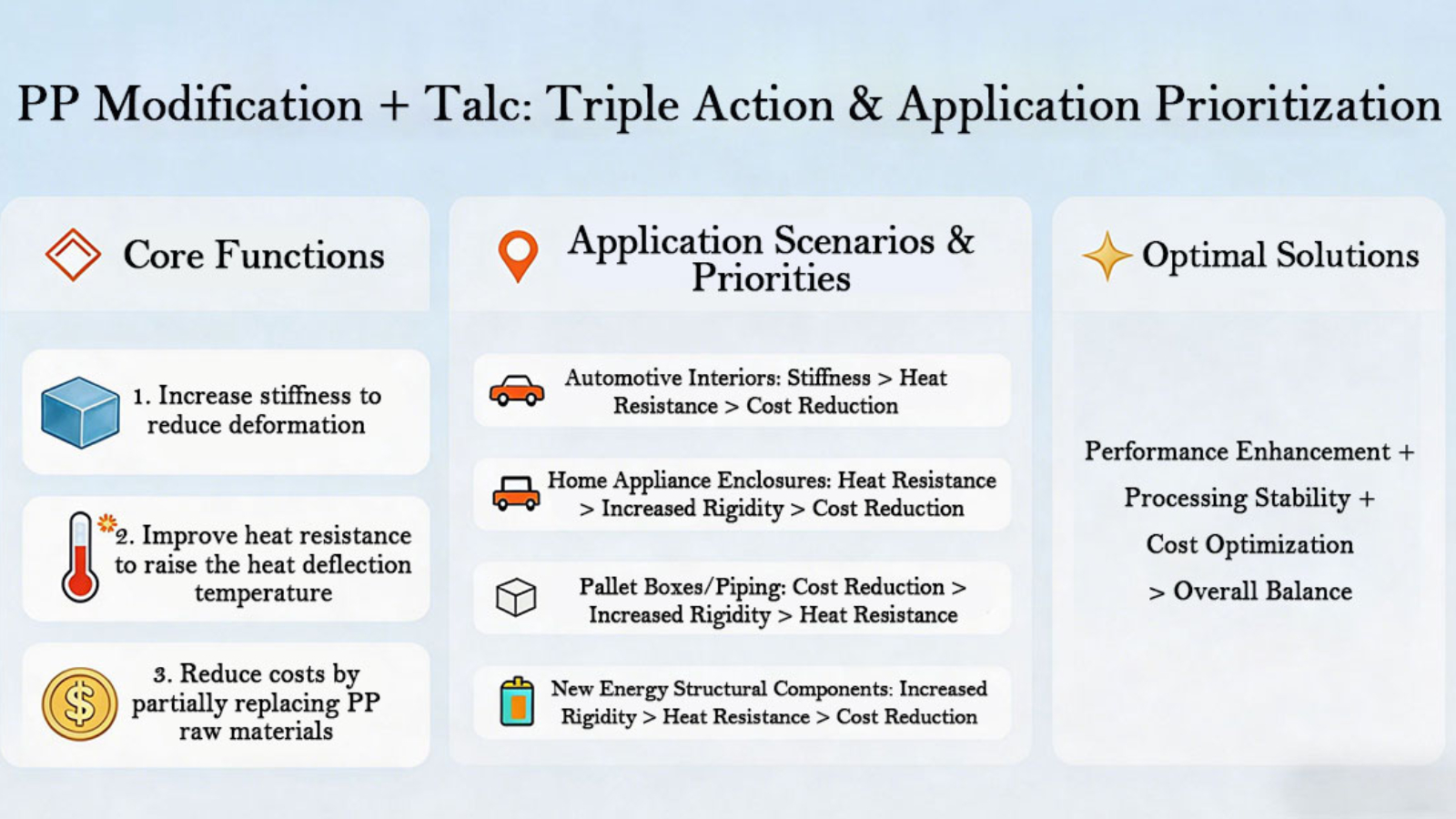
1. Increased Rigidity — The Performance Most Customers Focus on First
For injection-grade Polypropylene (PP) materials, the most direct effect of adding Talc Powder is a significant improvement in rigidity.
When talc powder is uniformly dispersed within the PP matrix, it restricts the movement of polymer molecular chains, thereby increasing flexural modulus and compressive strength, making the final product stiffer and more dimensionally robust.
Common applications include:
- Automotive instrument panels
- Door panel structural frames
- Home appliance structural components
- Storage boxes and logistics containers
- Industrial pallets
Especially under the trend of automotive lightweighting, “talc-filled reinforced PP” has become a mature and widely adopted solution for many OEM manufacturers.
2. Heat Resistance — A Key Indicator for High-End PP Modification
In addition to rigidity enhancement, talc powder can also significantly improve the thermal stability of PP.
PP resin tends to soften under high-temperature conditions, while talc, as an inorganic mineral filler, offers excellent thermal resistance. After being incorporated into the PP system, it can effectively increase the Heat Deflection Temperature (HDT) of the material.
This is particularly important in the following applications:
- Plastic components around automotive engine compartments
- Internal structural parts of air conditioners and washing machines
- Hot-fill packaging materials
- High-temperature plastic sheets
For many customers in the automotive plastics industry, heat resistance is often considered even more critical than cost reduction.
3. Dimensional Stability — An Often Overlooked Hidden Value
PP materials generally have a relatively high shrinkage rate during molding, especially for large injection-molded parts, which may lead to:
- Warpage
- Sink marks
- Dimensional deviation
- Assembly tolerance issues
The plate-like crystal structure of talc powder can effectively suppress PP crystallization shrinkage and significantly improve dimensional stability.
For precision assembly components, this advantage is often more important than simply improving rigidity.
4. Cost Reduction — A Practical Demand That Cannot Be Ignored
Of course, talc powder also delivers a very practical benefit: reducing overall raw material costs.
In PP formulations, replacing part of the resin with talc powder can significantly lower the material cost per ton.
Typical addition ratios include:
- 10% loading: Primarily focused on performance enhancement
- 20%–30% loading: A balance between performance and cost optimization
- Above 40% loading: High-filling solutions mainly for cost reduction
However, it is important to note that more talc is not always better.
If particle size, aspect ratio, or dispersion performance are not properly controlled, the following issues may occur:
- Reduced impact strength
- Brittleness of finished products
- Poor melt flow performance
- Surface powder migration or blooming
Therefore, cost reduction must always be based on stable product performance.
5. Rigidity, Heat Resistance, or Cost Reduction — Which Matters Most?
The answer depends on your end-use application:
| Application Field | Core Requirements |
|---|---|
| Automotive interior parts | Rigidity + Heat resistance + Dimensional stability |
| Home appliance housings | Rigidity + Surface appearance |
| Pipes and sheets | Dimensional stability + Cost reduction |
| Packaging products | Cost reduction + Processing efficiency |
| Engineering structural parts | Rigidity + Heat resistance |
Therefore, the true value of talc powder in PP modification is not limited to a single performance improvement. Instead, it helps manufacturers achieve the optimal balance among mechanical performance, processing stability, and production cost.
Add a Comment