
Abstract
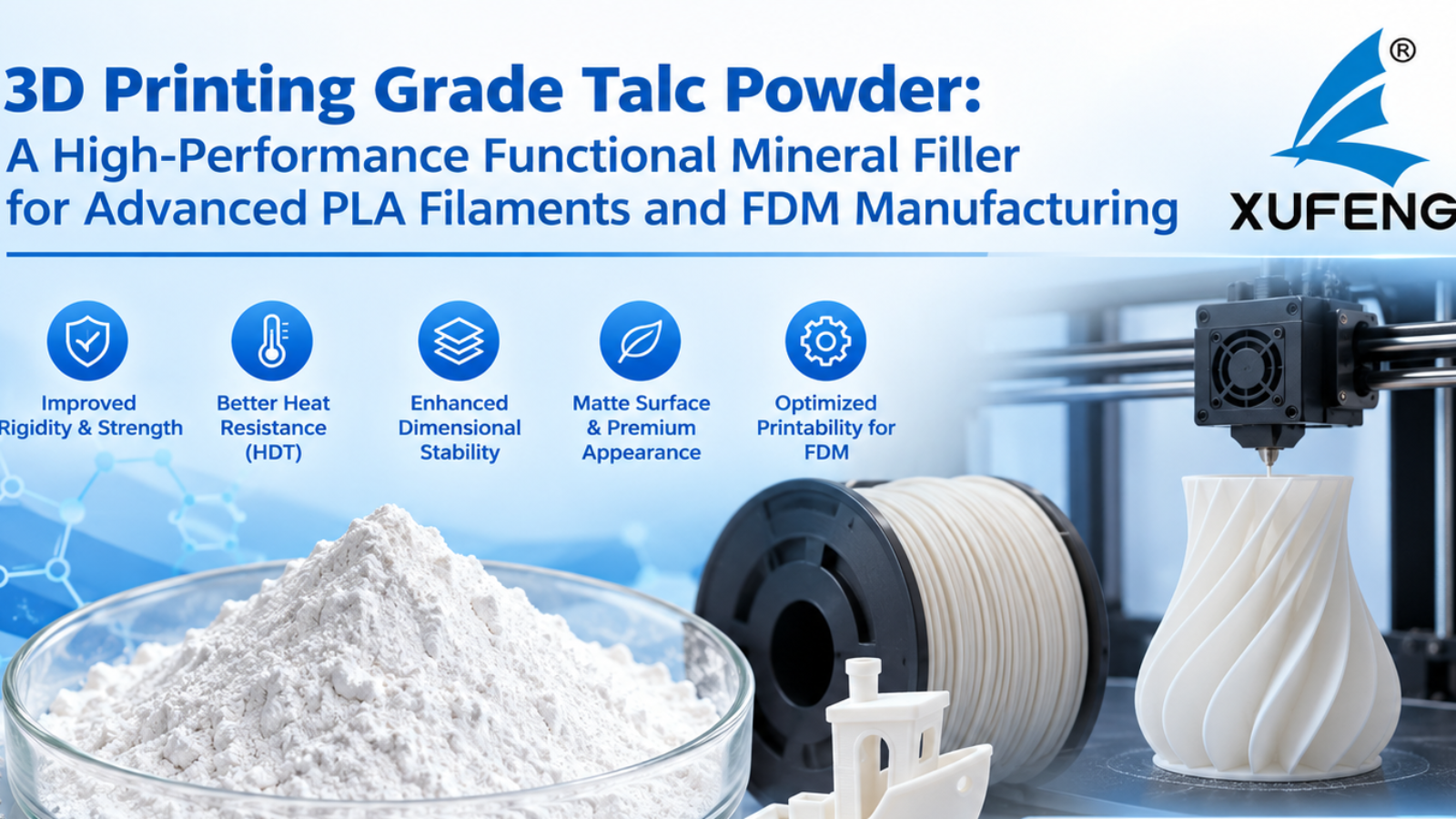
As Fused Deposition Modeling (FDM) continues to dominate the desktop and industrial additive manufacturing market, the demand for high-performance PLA composites has increased significantly. Conventional PLA exhibits excellent printability but suffers from inherent brittleness, limited heat resistance, and visible layer lines. Among various inorganic functional fillers, 3D printing grade talc powder has emerged as one of the most effective mineral additives for improving mechanical properties, dimensional stability, surface appearance, and production efficiency.
This paper discusses the characteristics of high-performance talc powder used in PLA filaments, its influence on extrusion and FDM printing behavior, and the advantages of combining functional mineral fillers with specialized masterbatch technology. Experimental results demonstrate that optimized mineral systems provide substantial improvements in interlayer adhesion, Z-axis strength, matte appearance, and high-speed printing performance compared with conventional talc or calcium carbonate fillers.
1. Introduction
Polylactic Acid (PLA) has become the most widely used material for FDM 3D printing due to its renewable origin, low warpage, and excellent printing stability. However, standard PLA often exhibits several limitations, including poor impact resistance, brittle fracture, insufficient interlayer bonding, and limited dimensional stability during large-scale printing.
To overcome these challenges, manufacturers increasingly incorporate functional mineral fillers into PLA formulations. Among them, ultra-fine 3D printing grade talc powder has attracted considerable attention because of its unique lamellar crystal structure, high aspect ratio, excellent thermal stability, and compatibility with biodegradable polymer systems.
Unlike conventional industrial talc, 3D printing grade talc is engineered specifically for filament extrusion and additive manufacturing, offering optimized particle size distribution, controlled surface treatment, superior dispersion, and improved processing consistency.
2. Characteristics of 3D Printing Grade Talc Powder
A high-quality talc powder for additive manufacturing should possess several critical characteristics:
- Ultra-fine particle size
- Narrow particle size distribution
- High whiteness
- Low moisture content
- Excellent dispersion
- High purity
- Surface modification for improved compatibility with PLA
The plate-like morphology of talc enables stress transfer within the polymer matrix, increasing stiffness while reducing shrinkage and warpage during cooling.
Compared with untreated mineral fillers, specially designed talc systems disperse more uniformly inside PLA, minimizing particle agglomeration and maintaining stable extrusion throughout filament production.
3. Advantages in PLA Filament Manufacturing
One major challenge during filament production is maintaining stable melt flow while preserving mechanical performance.
Specialized mineral masterbatch technology demonstrates significantly better compatibility with PLA than conventional powder filling. The dedicated masterbatch exhibits:
- Excellent dispersion
- High whiteness for easy color matching
- Improved toughness
- Reduced processing cost
- Stable processing behavior
- Direct blending capability with PLA without twin-screw compounding
- Cleaner production by eliminating powder dust during manufacturing
This approach simplifies production by allowing manufacturers to feed the masterbatch directly into a single-screw filament extrusion line, reducing both equipment investment and overall energy consumption.
4. Mechanical Performance Enhancement
Traditional mineral fillers often improve stiffness but reduce impact resistance and interlayer bonding.
Compared with PLA filled with conventional calcium carbonate or ordinary talc powder, the specialized mineral masterbatch achieved:
- Higher XY tensile strength
- Improved elongation at break
- Significantly higher Z-axis tensile strength
- Better flexural strength
The technical data indicate that the dedicated mineral formulation achieved approximately 28 MPa Z-axis tensile strength at 15% loading, while ordinary talc-filled PLA reached only about 7 MPa, highlighting the substantial improvement in interlayer adhesion.
This enhanced Z-direction performance is particularly important for functional engineering parts subjected to vertical loading.
5. Improved Printing Performance
Printability is equally important as mechanical performance.
Evaluation using multiple benchmark printing models showed that specialized mineral-filled PLA performed reliably across numerous printing scenarios, including:
- Ring models
- Grid structures
- Temperature towers
- Overhang testing
- Pyramid models
- Stringing evaluation
- Benchy boat
- Comprehensive functional models
The material maintained stable extrusion at printing temperatures ranging approximately from 190°C to 240°C and supported printing speeds up to 250 mm/s, with even higher speeds approaching 300 mm/s under optimized conditions before minor under-extrusion appeared.
These results indicate that properly engineered talc-based systems are suitable for modern high-speed FDM printers.
6. Matte Surface and Dimensional Stability
Surface quality has become a major selling point for consumer-grade PLA filaments.
Standard PLA generally produces glossy surfaces that readily reveal layer lines. High-fill matte formulations incorporating functional talc reduce surface gloss, creating a premium appearance while masking layer textures.
The technical documentation also notes that high-fill matte PLA systems benefit from:
- Easier extrusion
- Reduced die buildup
- Improved feeding stability
- Better appearance consistency
- Simplified color matching due to high brightness
Consequently, matte PLA has become increasingly popular for architectural models, artistic products, prototypes, and decorative components.
7. Manufacturing Efficiency and Sustainability
Beyond performance improvements, mineral masterbatch technology contributes to more sustainable manufacturing.
Traditional powder feeding often generates airborne dust, increasing cleaning requirements and affecting workshop conditions.
Pelletized mineral masterbatches eliminate powder handling during production, resulting in:
- Cleaner workshops
- Reduced dust pollution
- Improved operator safety
- More stable feeding
- Lower material loss
Furthermore, the PBAT-based carrier system reduces the amount of additional toughening resin required while maintaining excellent mechanical performance, thereby lowering formulation costs.
8. Industrial Applications
3D printing grade talc powder is widely applied in:
- PLA standard filament
- Matte PLA filament
- PLA Lite products
- Decorative printing materials
- Engineering prototype filament
- High-speed FDM filament
- Carbon fiber reinforced PLA
- Mineral-filled PLA composites
- Educational 3D printing materials
- Consumer desktop filament production
As additive manufacturing transitions toward industrial-scale production, demand for multifunctional mineral fillers is expected to continue growing.
Conclusion
3D printing grade talc powder has evolved beyond a simple cost-reduction filler into a high-performance functional mineral material that enhances the overall performance of PLA-based FDM filaments. Through optimized particle engineering and specialized masterbatch technology, manufacturers can achieve superior dispersion, enhanced interlayer adhesion, improved Z-axis tensile strength, excellent matte appearance, stable high-speed printing, and cleaner production processes.
As the global additive manufacturing industry increasingly demands stronger, faster, and more aesthetically refined materials, 3D printing grade talc powder will remain one of the most valuable functional mineral fillers for next-generation PLA filament development, offering an optimal balance between mechanical performance, processing efficiency, cost-effectiveness, and sustainability.
Add a Comment