
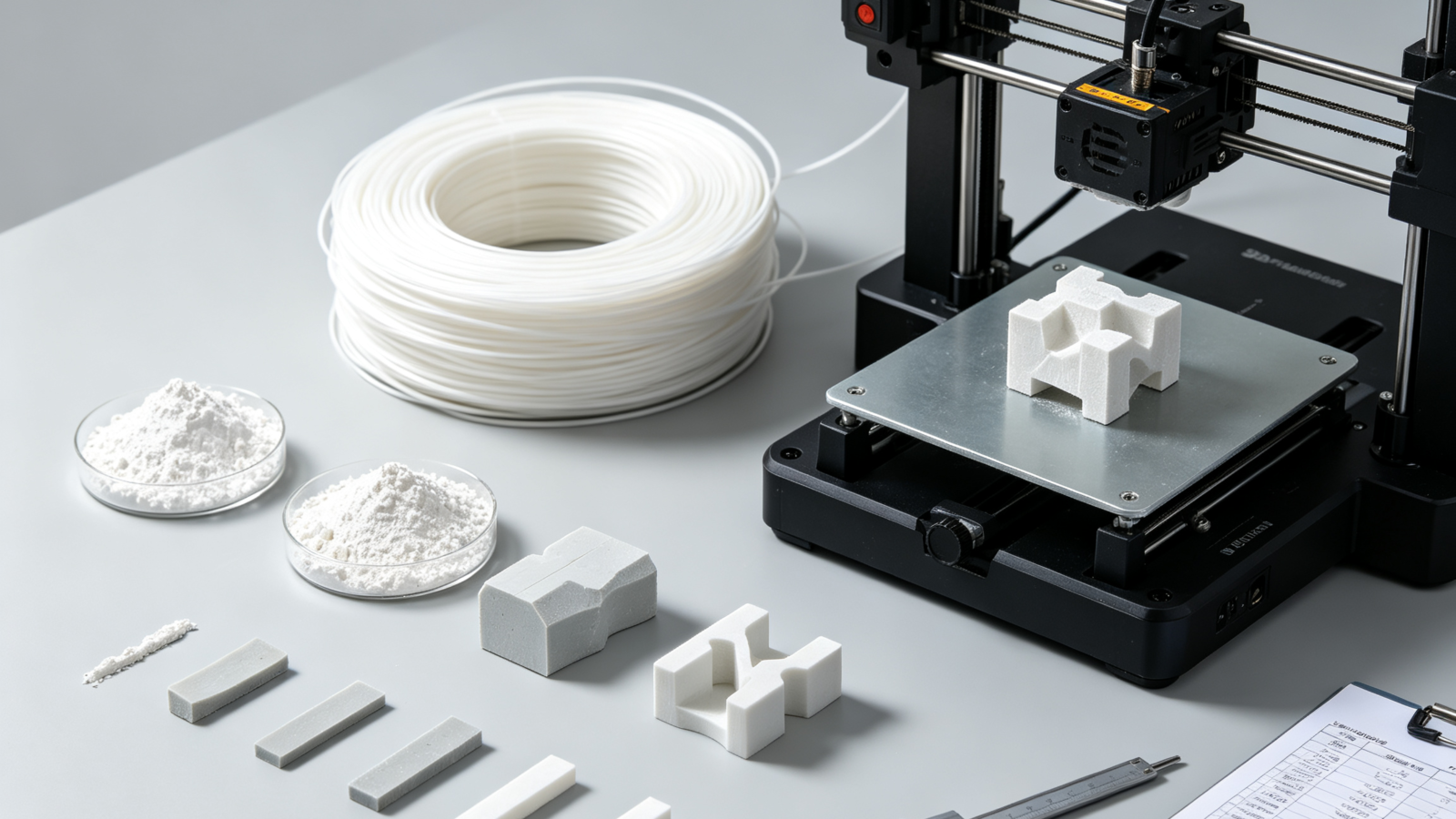
When purchasing talc powder for 3D printing filaments, buyers often compare whiteness first: Is 98% whiteness better than 96%?
The answer is: not necessarily.
For PLA, PETG and other 3D printing materials, talc whiteness mainly affects color and appearance. Overall filament performance also depends on particle size, particle size distribution, dispersion, oil absorption, moisture, surface treatment and mineral purity.
In other words, high whiteness is valuable—but it should not be treated as the only indicator of a high-performance 3D printing talc.
1. What Does Talc Whiteness Mean?
Talc whiteness describes the visual brightness or light-reflecting characteristics of the mineral powder. Natural talc can contain different levels of impurities, such as iron-bearing minerals, carbonaceous materials and other associated minerals, which can affect its color.
High-whiteness talc is particularly useful for:
- White PLA filaments
- Light-colored filaments
- Custom-color materials
- Semi-transparent systems
- Applications with strict appearance requirements
For these applications, consistent talc whiteness can help reduce color variation and make formulation and color matching easier.
2. Does Higher Whiteness Mean Better Mechanical Performance?
No.
Consider two talc grades:
Grade A: 98% whiteness but moderate dispersion
Grade B: 96% whiteness with better particle size, dispersion and PLA compatibility
For a high-performance PLA filament, Grade B may deliver better overall results.
Mechanical and processing performance is influenced by particle size, morphology, dispersion, interfacial interaction, filler loading, PLA grade and crystallization behavior rather than whiteness alone.
Therefore, whiteness should be regarded primarily as an appearance-related parameter, not a direct measure of reinforcement performance.
3. High Whiteness Does Not Automatically Mean High Purity
Whiteness and mineral purity can be related, but they should not be considered equivalent.
A talc powder may have high visual whiteness while still requiring careful evaluation of particle distribution, agglomeration, moisture, oil absorption and surface treatment.
For 3D printing applications, a more complete evaluation should include:
| Parameter | Main Consideration |
|---|---|
| Whiteness | Color and appearance |
| Particle size | Dispersion, crystallization and mechanical properties |
| Particle distribution | Processing stability |
| Oil absorption | Rheology and resin demand |
| Moisture | Extrusion stability |
| Surface treatment | PLA compatibility |
| Purity | Overall material consistency |
| Morphology | Reinforcement and crystallization |
4. What About Transparent PLA?
High whiteness does not mean high transparency.
Talc is an inorganic mineral filler. Once incorporated into PLA, it can change the optical properties of the material. For transparent or low-haze filaments, manufacturers need to consider particle size, refractive-index differences, dispersion, filler loading and agglomeration.
Therefore:
High whiteness helps with color control; transparency requires a different material-design strategy.
5. How Should Manufacturers Select 3D Printing Talc?
The right selection depends on the application.
For black or dark-colored PLA, whiteness may be less critical. For white and pastel filaments, high and stable whiteness becomes more important. For transparent or semi-transparent materials, optical testing should be prioritized rather than relying on whiteness alone.
Xufeng’s 3D printing talc solutions are developed with multiple parameters in mind, including whiteness, particle size, oil absorption, surface treatment and moisture. Different grades can be evaluated according to the specific PLA or PETG formulation and filament extrusion process.
Conclusion
Higher talc whiteness does not automatically mean better 3D printing filament performance.
If the goal is excellent color and appearance, high whiteness can provide clear benefits. If the goal is improved stiffness, crystallization, dimensional stability or extrusion performance, however, manufacturers need to evaluate the complete powder-performance profile.
For 3D printing-grade talc, the better question is not simply “Is it 96% or 98% white?”
It is:
“Does this talc provide the right balance of whiteness, particle size, dispersion, compatibility and final printing performance?”
Add a Comment