
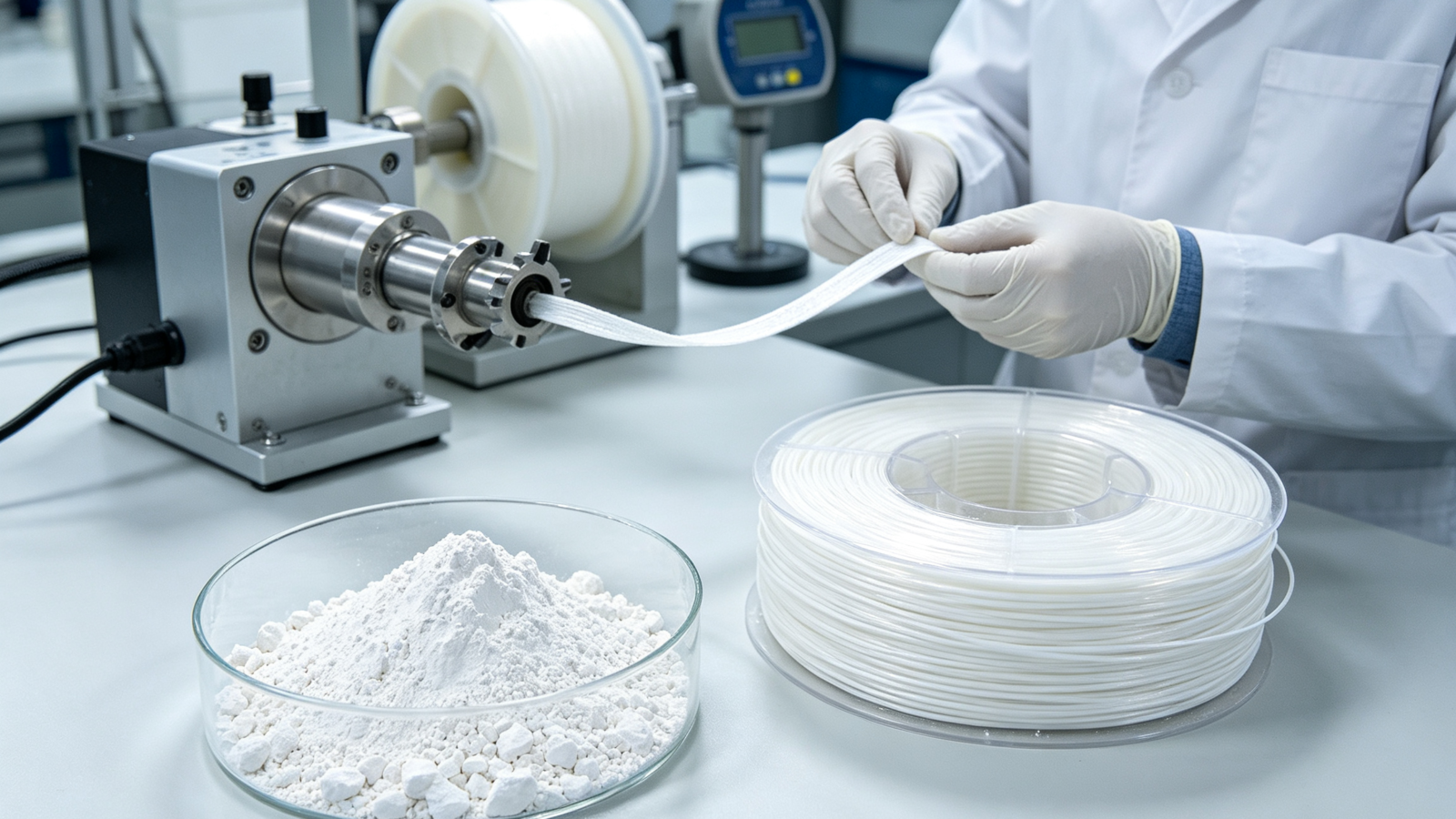
When developing PLA, PETG or other 3D printing filaments, buyers often focus on talc whiteness, price and loading level. For formulation engineers and filament manufacturers, however, talc particle size is another critical parameter.
Two talc powders with different particle sizes can produce very different results in PLA. Particle size can influence dispersion, crystallization, melt rheology, filament extrusion stability and the mechanical performance of the final printed part.
For 3D printing-grade talc, therefore, “mesh size” alone is not enough. Parameters such as D50, D97, particle size distribution and actual dispersion performance should be evaluated together.
1. Why Does Talc Particle Size Affect PLA?
Talc is a layered mineral filler. During PLA compounding, the material passes through feeding, melting, shear mixing, dispersion, extrusion, cooling and filament forming.
Finer talc particles generally provide a higher specific surface area. This can create more interfaces between talc and PLA and provide more potential nucleation sites for crystallization.
However, a larger surface area also increases the requirements for powder dispersion, moisture control, surface treatment and processing conditions.
This leads to an important principle:
Finer talc is not always better. The target is the right balance between particle size, dispersion and processability.
2. Particle Size Can Change PLA Crystallization
Research directly comparing 1 μm, 5 μm and 30 μm talc in PLA found that particle size affects crystallization behavior. With only 1 wt% talc, the crystallization temperature decreased substantially, while finer talc showed slightly stronger crystallization-promoting effects.
The reason is related to heterogeneous nucleation. Fine talc particles can provide more mineral-polymer interfaces where PLA molecular chains can organize into crystalline structures.
This is particularly relevant to FDM printing because PLA normally experiences very rapid cooling after extrusion. Research on PLA/talc filaments has shown that talc can promote crystallization during FFF, increasing crystallinity and contributing to higher flexural modulus and better mechanical integrity.
3. Smaller Particles Do Not Automatically Mean Better Dispersion
Particle size must also be considered together with dispersion.
If talc powder is poorly dispersed, fine particles can form agglomerates. These agglomerates may create local high-filler regions, uneven melt flow and stress concentration points.
For filament manufacturers, this can lead to:
- Unstable extrusion pressure
- Filament diameter variation
- Rough filament surfaces
- Local particle defects
- Increased nozzle clogging risk
- Uneven printed surfaces
Therefore, evaluating talc only by its D50 value is insufficient.
A more complete evaluation should include D50, D97, particle size distribution, agglomeration, moisture, surface treatment, oil absorption and compatibility with the selected PLA grade.
4. Why Does Particle Size Matter During Filament Extrusion?
Unlike conventional plastic compounding, 3D printing filament production requires a highly stable final product with a controlled diameter and consistent material structure.
Adding talc changes the rheological behavior of the PLA system. Particle size, filler loading and dispersion can all influence melt viscosity and flow behavior.
For this reason, a suitable 3D printing talc grade needs to work throughout the entire process:
Talc powder → PLA compounding → Filament extrusion → FDM printing → Final printed part
The best powder is therefore not necessarily the finest powder. It is the powder that provides the required functional effect while maintaining stable compounding and filament extrusion.
5. How Should Manufacturers Select Talc for 3D Printing?
A practical three-step evaluation can be used.
Step 1: Particle size screening
Compare talc grades with different D50 values, for example approximately 1 μm, 2 μm and 5 μm.
Step 2: Filament extrusion testing
Monitor melt pressure, extrusion stability, filament diameter variation, surface quality and dispersion.
Step 3: FDM printing validation
Evaluate tensile strength, elongation, flexural performance, Z-direction strength, dimensional stability and actual print quality.
The final decision should be based on filament and printed-part performance, rather than powder specifications alone.
6. Why Is Particle Size Important in 3D Printing-Grade Talc?
For specialty talc used in PLA and other 3D printing materials, particle size should be designed together with other powder characteristics.
A suitable formulation may require a balance of:
Particle size + dispersion + moisture + surface treatment + oil absorption + PLA compatibility + processing conditions
Xufeng develops specialty talc solutions for PLA and other 3D printing filament applications, with different particle-size and performance profiles. Talc selection can be evaluated according to the specific PLA grade, filler loading, filament extrusion process and target printed-part performance.
Conclusion
Talc particle size is important because it can influence PLA crystallization, powder dispersion, melt rheology and filament extrusion stability.
The goal should not simply be to choose the finest talc available. Instead, manufacturers should select the particle size that delivers the best balance of nucleation, reinforcement, dispersion, processability and final printing performance.
For 3D printing filament manufacturers, the key question is therefore not simply:
“How fine is the talc?”
but rather:
“Does this particle size deliver stable extrusion and the required performance in the final printed part?”
Add a Comment